


Kent, Surrey and Sussex (KSS)
KSS has a dedicated service funded to transfer babies between neonatal units. We have three teams based in Medway, Chertsey and Brighton who operate on a rotation of day and night shifts to make sure a 24–hour service is available across all three counties.
Please click here to see the current transport team rota.
Our teams are made up of highly skilled doctors and nurses who have received specialist training in the transfer of premature and sick babies.
We have two teams:
- Full team – a doctor or advanced neonatal nurse practitioner (ANNP), a neonatal nurse and an ambulance driver.
- Nurse only team– a neonatal nurse (or sometimes a doctor or ANNP) and an ambulance driver.
The team you meet will depend on the category of transfer and the needs of your baby. All teams are overseen by a neonatal consultant.
Neonatal Transport Service Virtual Tour
Click the image below to see a walkthrough of the neonatal ambulance and transport incubator. For a guided tour, select the play button in the bottom left-hand corner.
Trigger warning
If you are a parent or carer and wish to use the virtual tours to explore the neonatal unit where your baby was cared for, please make sure you are in a safe space and feel emotionally ready to revisit the unit. Some parents have told us that revisiting the unit, even years down the line, can bring back emotional memories, so please take care.
Why does a baby need our service?
A premature baby may be very sick and therefore need intensive care or specialist treatment on a neonatal intensive care unit (NICU) and we have been called to arrange their transfer. The initial management of the baby will have been delivered by the local team with some advice from our team. The baby may need transfer to another neonatal unit for other reasons including staff or equipment shortages.
The neonatal unit currently caring for the baby is part of the Kent, Surrey and Sussex Neonatal Operational Network. We will always try to place a baby in the most appropriate unit to meet their needs, closest to their home. If no neonatal cots are available in Kent, we will transport the baby to the nearest available neonatal bed within the network (Kent, Surrey or Sussex). If no appropriate bed is available within the network, or additional specialist services are needed (cardiology or neurology), we will look to neighbouring network hospitals in London or Thames Valley and Wessex.
What happens next?
When we arrive at the hospital, we will need to assess the baby and take details about their condition and medical care so far. We may need to spend some more time with the baby carrying out further treatment before it is safe to transfer them. A parent may be with the baby. Parents are free to ask us questions; it is important they fully understand what is happening.
If a parent is not able to see their baby on the neonatal unit due to their own postnatal treatment, our team can bring the baby to see them in our transport incubator before we go to the ambulance, this is an opportunity to take photos.
We will provide parents with written information specific to the hospital and unit to which their baby is being transferred including directions, a map, contact numbers, and details about local facilities, including parent accommodation. All hospitals offer different facilities to parents.
Can parents travel with their baby?
On most occasions one parent can travel with their baby. The parent will sit at the front of the ambulance next to the driver. They may bring one piece of luggage. Mums need to be at least 24–hours post-delivery, fit for hospital discharge from maternity and well enough to travel. There are occasions when it is not possible to take a parent. We apologise for this and will try to communicate this to the local team as early as possible.
If you are still an inpatient at the hospital where your baby was born, it may be possible for you to be transferred to the maternity unit where your baby is being transferred to. This is arranged by your local maternity unit. However, this is dependent on your current condition, bed availability at the receiving hospital and your local unit’s ability to arrange transfer and provide a midwife to travel with you.
It may be that parents need to arrange their own transport. The transport team can provide them with details of how to find the hospital and the unit once they arrive. For safety reason it is important they do not try to follow the ambulance because this can be dangerous.
Moving baby closer to home
A Kent, Surrey and Sussex neonatal transport team will transfer (repatriate) a baby back to their local hospital for their ongoing care when intensive or specialist care is no longer needed and a cot becomes available. The local hospital will support parents and their baby until the baby is ready to be discharged home. Due to the transfer service giving priority to the most poorly baby who needs transferring, sometimes there can be a delay in repatriating babies. We apologise for any delay and will try to keep this to a minimum.

Thames Valley and Wessex (TVW)
TVW neonatal transport is provided by the Southampton Oxford Neonatal Transport service (SONeT). The team has 2 hubs based at Oxford in Thames Valley and Southampton in Wessex. The service provides both emergency and a repatriation 24hr service, undertaking approximately 1200 transfers a year. You can find out more about the service on their website: SONeT (sort.nhs.uk)
Transfer Closer to Home: The neonatal repatriation of your baby
Watch our short animation:

A transport incubator
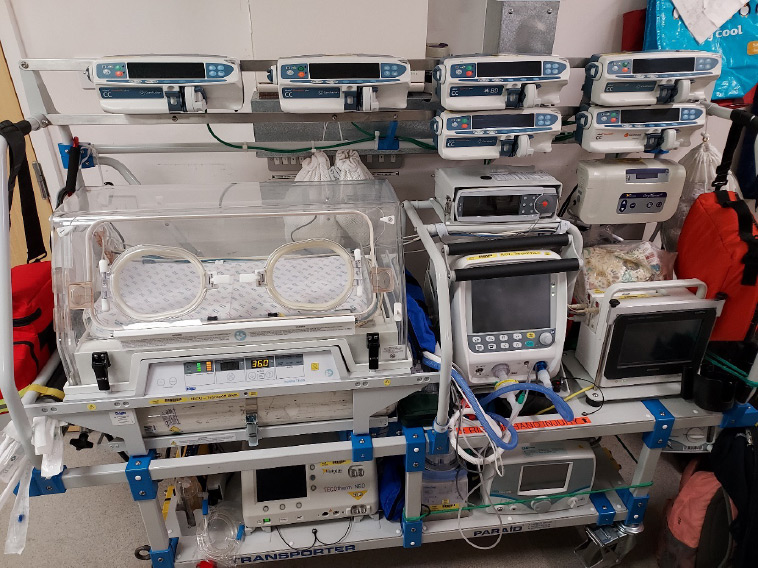
Incubator – keeps babies warm, protects from noise and infection. We cover the incubator for privacy when moving from the neonatal unit to the ambulance.
Ventilator – one machine that can be used for many different types of breathing support.
Infusion pumps – to give fluids and medication during journey.
Heated mattress – extra heat for our extra small babies to keep them warm
Monitors – similar to monitors used in the neonatal units, help us to observe baby’s heart rate, breathing and temperature.